Tell us a little about you! Where you live, what you like to do for fun, etc etc.
My name is Monica. I am a designer and fine artist living in New York City, originally from Manila, Philippines. I live in a small studio apartment in lower Manhattan that I love to work and host from. I am currently the art director at Gohar World, a design company that works closely with partners in food and fashion.
As creating art is what I do professionally, I spend my spare time on adjacent activities that don’t necessarily require me to produce more of it. It's a privilege to be able to view and experience beautiful things without it having to feel like work! I love visiting galleries, sitting underneath hotel bar murals (Bemelmans at the Carlyle is my favorite), and drawing on restaurant table butcher paper at dinner. My ideal evening — one I accidentally find myself repeating every other week — is to sit at the bar at Estela, splitting scallops and a bottle of wine with my girlfriends.
Much of your work sits between illustration and fine art. How do you see yourself within those boundaries? [I would say that my work sits more between design and fine art, with illustration falling underneath fine art!]
I was trained formally in painting and illustration at university, but was drawn to design as it allows art — something usually seen as very abstract and subjective — to structure systems and solve visual problems. I love working with collaborators that let me integrate my fine art practice into entrepreneurial efforts or initiatives. I like art that shares a purpose: to sell, to rally, to inspire. I am teaching myself to let go (to create art for arts sake!), but I have a huge, blank, two year-old canvas in my studio that has yet to be painted.
Your practice is highly detailed and precise. What draws you to this level of intensity?
I primarily work with graphite and realism as I feel the combination of the two creates the sharpest, most cutting image. I love the relationship between light and shadow, and value the ability to capture that within only a single shade or color. It's very a traditional, draftsmanship-like practice, but one that can be very romantic when paired with the right subject.
When approaching the Tulip series, what image or idea came to you first?
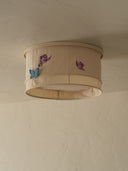
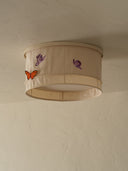
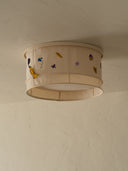
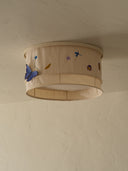
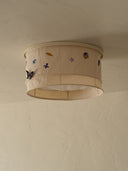
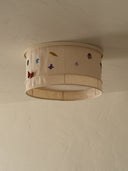
Earlier in the summer, my initial idea was to paint butterflies perched on the Tulip shades. I grew up in a very tropical country and one of my earliest memories is watching insects gather on my grandmother's linen lamp. After a few rounds of testing, I learned that large butterflies obscure too much light from the shade; I pivoted instead to the idea of painting smaller, found flora, debris, and objects. Living in New York leads me to see the strangest things on the ground — I love finding petals, sticks, fragments of life. I narrowed my focus to the beauty of found flora, eventually painting larger tulips, too, as a tie back to the brand’s name.
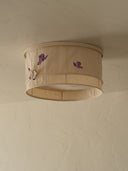
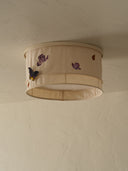
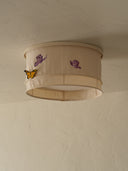
The butterfly idea lingered in my mind. At the very last second — right before I had to ship the collection out to California! — I unearthed the test shades from the summer and cut out the butterflies I had painted originally. I adhered them onto brooch pins and fastened them across the flora. The collection immediately felt more resolved, more me, and more Tulip. The Tulip team was generous enough to grant me more time to develop the butterfly pins further. I love the play and interaction between both motifs, and the dimension of the final product.
Your past projects include collaborations with design houses like Gohar World and Bode. What makes a collaboration meaningful for you?
I love working with collaborators that have a strong sense of self and a regard for traditional art. Trust is also very important — partners who welcome a collaborator’s interpretation of the brand, recognizing that they hold similar values. Gohar World is a very tactile and physical brand despite living primarily on the internet. We create everything by hand: sketching, painting, printing, cutting. It has such a strong personality, but also allows my own — as an illustrator and fine artist — to shine through.
I also love collaborators that are rooted in history. This holiday season, I am excited to begin an illustrator residency at The Carlyle. Bemelmans Bar has an incredible mural that I spent my very first New York birthday with — I’m honored to be part of the nearly-100 year-old hotel’s history and am so proud to be able to draw where Ludwig Bemelmans (the creator of Madeline!) drew.
This collaboration with Tulip has been one of the most meaningful yet. It is such a brilliant product, backed by a very kind and creative team. The concept is simple, yet straightforwardly solves a shared, underlying issue within the New York City community. Adding beauty to small spaces is no small feat. Tulip’s eye for collaboration, too, is unmatched — supporting and partnering with small artists to create one-off designs. I’m very lucky to have worked with Lori, the genius founder, and her incredibly talented team.
If this series could sit alongside another body of work you admire, what would it be?
I love the work of Jan Van Kessel from the 17th century, illustrated plates of flora and fauna in scientific manuscripts, and old magazine advertisements painted by fine artists that — at that time — were not yet recognized as fine artists.
What does it mean to you to create work that people live with in their homes?
It’s quite surreal to me to have my work live in the homes of others, some maybe complete strangers. I’ve never sold my art before — I never feel ready to do so, but then again, when is one ever ready! — so this is a big first for me. I’m grateful for the support of the unnamed customers, but firstly to the Tulip team that brought me this opportunity. I’m excited to see where customers will place their shades, and am honored to contribute to expressions of their personal style.
If someone acquires one of these pieces, what do you hope they feel when they turn on the light?
I’d love for them to feel safe, at peace, and genuinely at home whenever the Tulip lamp is turned on.
What inspired your design? What materials did you use? What was your process?
I wanted to paint fragments of found flora and fauna around the shades, complemented by three-dimensional butterfly pins that customers could attach anywhere on their shade — inspired by the insects that used to perch on my grandmother’s lamps in the Philippines.
I used textile paint throughout the collection. I began by sketching the placement of the motifs around the shade, then proceeded to paint shared hues (blues for flowers, greens for leaves) to optimize blending ability and drying time. Once the collection was complete, I signed and numbered each shade — packing them up carefully to ship back to the Tulip team in California. I left a special note with each shade, on stationery I designed to accompany the collection and house the butterfly pins.











Get to Know Monica Magsanoc
Tell us a little about you! Where you live, what you like to do for fun, etc etc.
My name is Monica. I am a designer and fine artist living in New York City, originally from Manila, Philippines. I live in a small studio apartment in lower Manhattan that I love to work and host from. I am currently the art director at Gohar World, a design company that works closely with partners in food and fashion.
As creating art is what I do professionally, I spend my spare time on adjacent activities that don’t necessarily require me to produce more of it. It's a privilege to be able to view and experience beautiful things without it having to feel like work! I love visiting galleries, sitting underneath hotel bar murals (Bemelmans at the Carlyle is my favorite), and drawing on restaurant table butcher paper at dinner. My ideal evening — one I accidentally find myself repeating every other week — is to sit at the bar at Estela, splitting scallops and a bottle of wine with my girlfriends.
Much of your work sits between illustration and fine art. How do you see yourself within those boundaries? [I would say that my work sits more between design and fine art, with illustration falling underneath fine art!]
I was trained formally in painting and illustration at university, but was drawn to design as it allows art — something usually seen as very abstract and subjective — to structure systems and solve visual problems. I love working with collaborators that let me integrate my fine art practice into entrepreneurial efforts or initiatives. I like art that shares a purpose: to sell, to rally, to inspire. I am teaching myself to let go (to create art for arts sake!), but I have a huge, blank, two year-old canvas in my studio that has yet to be painted.
Your practice is highly detailed and precise. What draws you to this level of intensity?
I primarily work with graphite and realism as I feel the combination of the two creates the sharpest, most cutting image. I love the relationship between light and shadow, and value the ability to capture that within only a single shade or color. It's very a traditional, draftsmanship-like practice, but one that can be very romantic when paired with the right subject.
When approaching the Tulip series, what image or idea came to you first?
Earlier in the summer, my initial idea was to paint butterflies perched on the Tulip shades. I grew up in a very tropical country and one of my earliest memories is watching insects gather on my grandmother's linen lamp. After a few rounds of testing, I learned that large butterflies obscure too much light from the shade; I pivoted instead to the idea of painting smaller, found flora, debris, and objects. Living in New York leads me to see the strangest things on the ground — I love finding petals, sticks, fragments of life. I narrowed my focus to the beauty of found flora, eventually painting larger tulips, too, as a tie back to the brand’s name.
The butterfly idea lingered in my mind. At the very last second — right before I had to ship the collection out to California! — I unearthed the test shades from the summer and cut out the butterflies I had painted originally. I adhered them onto brooch pins and fastened them across the flora. The collection immediately felt more resolved, more me, and more Tulip. The Tulip team was generous enough to grant me more time to develop the butterfly pins further. I love the play and interaction between both motifs, and the dimension of the final product.
Your past projects include collaborations with design houses like Gohar World and Bode. What makes a collaboration meaningful for you?
I love working with collaborators that have a strong sense of self and a regard for traditional art. Trust is also very important — partners who welcome a collaborator’s interpretation of the brand, recognizing that they hold similar values. Gohar World is a very tactile and physical brand despite living primarily on the internet. We create everything by hand: sketching, painting, printing, cutting. It has such a strong personality, but also allows my own — as an illustrator and fine artist — to shine through.
I also love collaborators that are rooted in history. This holiday season, I am excited to begin an illustrator residency at The Carlyle. Bemelmans Bar has an incredible mural that I spent my very first New York birthday with — I’m honored to be part of the nearly-100 year-old hotel’s history and am so proud to be able to draw where Ludwig Bemelmans (the creator of Madeline!) drew.
This collaboration with Tulip has been one of the most meaningful yet. It is such a brilliant product, backed by a very kind and creative team. The concept is simple, yet straightforwardly solves a shared, underlying issue within the New York City community. Adding beauty to small spaces is no small feat. Tulip’s eye for collaboration, too, is unmatched — supporting and partnering with small artists to create one-off designs. I’m very lucky to have worked with Lori, the genius founder, and her incredibly talented team.
If this series could sit alongside another body of work you admire, what would it be?
I love the work of Jan Van Kessel from the 17th century, illustrated plates of flora and fauna in scientific manuscripts, and old magazine advertisements painted by fine artists that — at that time — were not yet recognized as fine artists.
What does it mean to you to create work that people live with in their homes?
It’s quite surreal to me to have my work live in the homes of others, some maybe complete strangers. I’ve never sold my art before — I never feel ready to do so, but then again, when is one ever ready! — so this is a big first for me. I’m grateful for the support of the unnamed customers, but firstly to the Tulip team that brought me this opportunity. I’m excited to see where customers will place their shades, and am honored to contribute to expressions of their personal style.
If someone acquires one of these pieces, what do you hope they feel when they turn on the light?
I’d love for them to feel safe, at peace, and genuinely at home whenever the Tulip lamp is turned on.
What inspired your design? What materials did you use? What was your process?
I wanted to paint fragments of found flora and fauna around the shades, complemented by three-dimensional butterfly pins that customers could attach anywhere on their shade — inspired by the insects that used to perch on my grandmother’s lamps in the Philippines.
I used textile paint throughout the collection. I began by sketching the placement of the motifs around the shade, then proceeded to paint shared hues (blues for flowers, greens for leaves) to optimize blending ability and drying time. Once the collection was complete, I signed and numbered each shade — packing them up carefully to ship back to the Tulip team in California. I left a special note with each shade, on stationery I designed to accompany the collection and house the butterfly pins.